
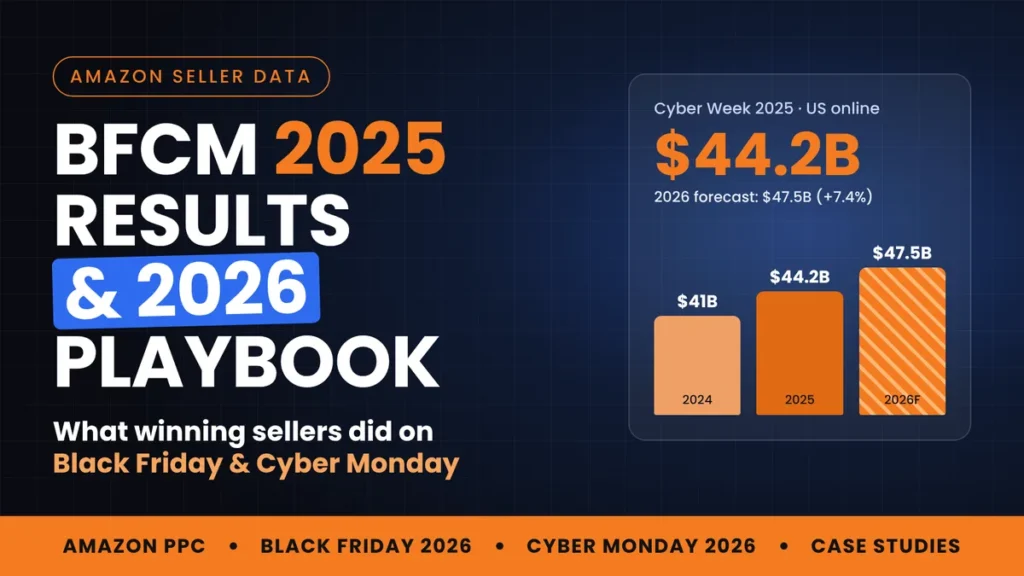
Amazon BFCM 2025 broke records again, but not every seller shared in it. US shoppers spent $44.2 billion online during Cyber Week 2025, Black Friday grew faster than Cyber Monday, and some Amazon brands grew their Black Friday week sales by more than 50%. At the same time, plenty of sellers on the Seller Central forums called it their weakest holiday in years.
So what separated the winners from everyone else? This guide breaks down the real numbers from Black Friday and Cyber Monday 2025, what successful Amazon sellers did differently, what happened to Amazon PPC costs, and how to use all of it to plan your Amazon BFCM 2026 strategy. It’s the same data our team at ECom Ward, an Amazon management agency, uses to plan the holiday season for the brands we work with.
Short on time? Amazon’s final deal submission deadline for Black Friday Week and Cyber Monday 2026 is October 20, and FBA inventory needs to arrive by October 21 (minimal shipment splits) or October 28 (Amazon-optimized splits). If you haven’t done those yet, start there, then come back to this article. Our step-by-step BFCM 2026 prep plan walks through every deadline.
Amazon BFCM 2025 Results at a Glance
BFCM on Amazon is no longer one Friday and one Monday. It’s a 12-day deal event that drives a big share of many sellers’ yearly revenue. Here are the headline Black Friday Cyber Monday 2025 numbers from Adobe Analytics, which tracks more than a trillion visits to US retail sites:
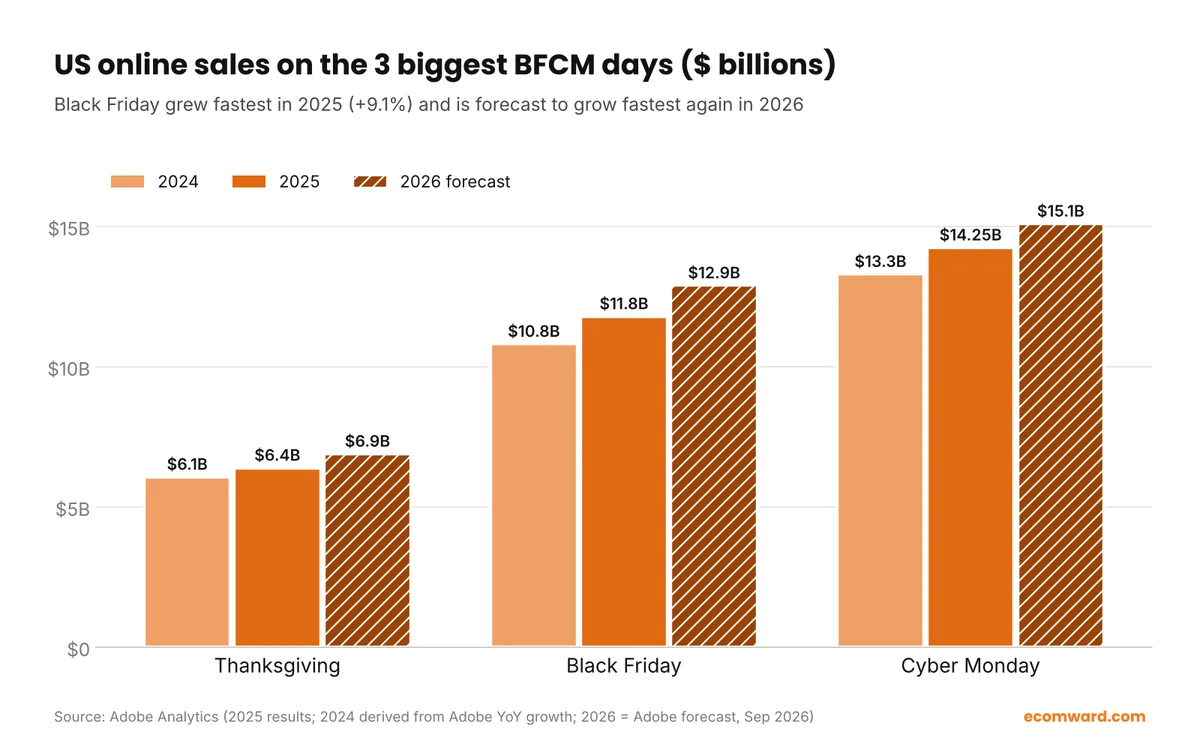
A few things stand out from the 2025 results:
- Black Friday is catching up with Cyber Monday. Black Friday grew 9.1% while Cyber Monday grew 7.1%. Adobe’s analysts said competitive deals all week pushed shoppers to buy earlier, so Black Friday now challenges Cyber Monday’s lead.
- The whole season hit a record. US shoppers spent $257.8 billion online between November 1 and December 31, 2025, up 6.8%.
- Shoppers used AI to find deals. Traffic to US retail sites from generative AI tools jumped by roughly 805% in November, and about 693% across the full season. On Amazon, that means Rufus and outside AI assistants increasingly decide which listings get seen.
- Discounts were deep. Electronics discounts peaked at 30.9% off list price, and Buy Now, Pay Later passed $1 billion on Cyber Monday alone.
How long was Amazon’s Black Friday event in 2025?
Amazon’s Black Friday Week and Cyber Monday deal event ran for 12 days, from November 20 to December 1, 2025. For 2024 it also ran 12 days (November 21 to December 2), and Amazon said more than 60% of sales in its store during that event came from independent sellers.
One thing changed in 2025: for the first time since at least 2016, Amazon didn’t publish its usual “biggest ever” Black Friday and Cyber Monday recap. It folded holiday event results into its quarterly earnings instead. That makes independent data, like the ad benchmarks and seller case studies below, more useful than ever.
What Happened to Amazon PPC During Black Friday and Cyber Monday 2025
Amazon PPC is where most sellers win or lose BFCM. The average Amazon cost per click was already around $1.04 in 2025, up from about $0.89 in 2023, and holiday keywords get far more expensive during Cyber 5. But the 2025 data from Pacvue and Helium 10’s Cyber 5 benchmark report, based on thousands of advertisers, tells a more interesting story.
Brands spent more on Black Friday and less on Cyber Monday
Average daily Sponsored Products and Sponsored Brands spend on Amazon US rose 4.4% year over year on Black Friday, but fell 6.7% on Cyber Monday. Advertisers followed the shoppers: more people bought on Black Friday instead of waiting for Cyber Monday deals.
Sponsored Brands beat Sponsored Products
In 2024, Sponsored Products delivered about 1.3x the ROAS of Sponsored Brands during Cyber 5. In 2025 that flipped. Sponsored Brands ROAS rose 25.2% on Black Friday to $6.85, helped by higher conversion rates and bigger orders. If your Black Friday Amazon ads were only Sponsored Products, you likely missed the best-performing format of the weekend.
Several big categories got cheaper clicks and better returns
Not every category got more expensive. Research-heavy and trend-driven categories saw lower CPCs and higher ROAS, likely because shoppers arrived on Amazon already knowing what they wanted after using AI tools, TikTok and creator gift guides.
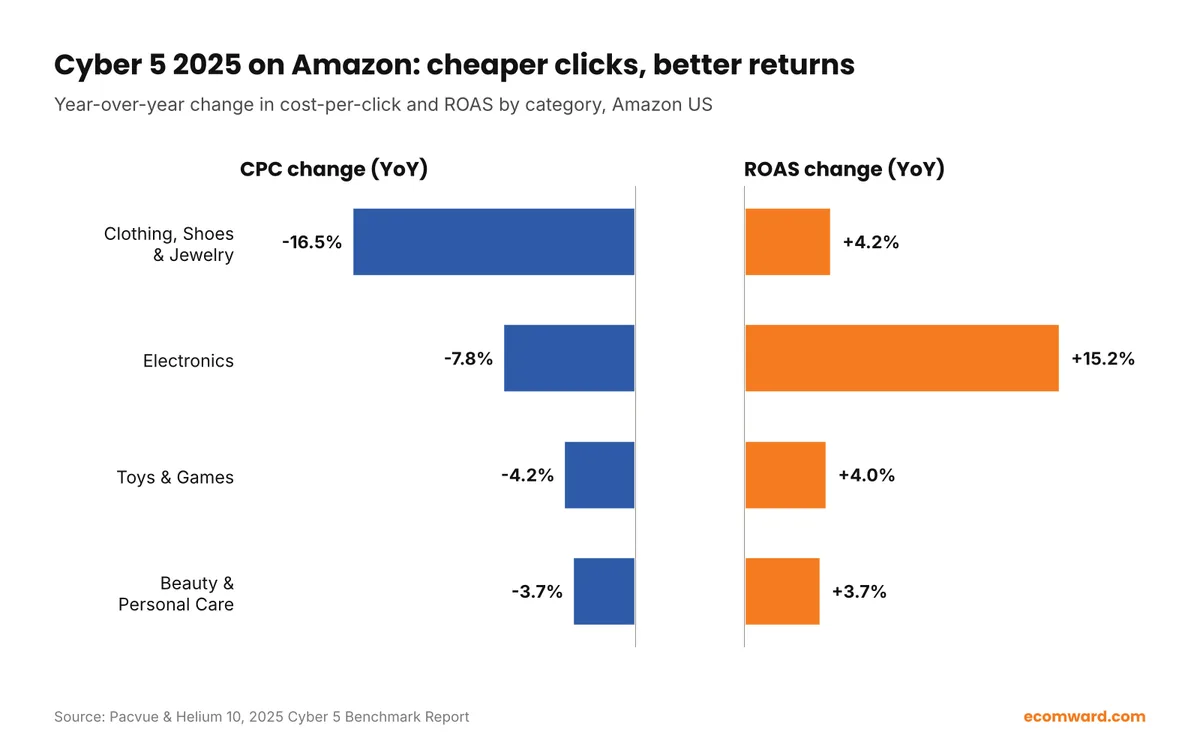
Meanwhile, Pet Supplies and Baby Products saw major CPC increases, and essentials like Grocery and Health & Household had strong conversion rates and ROAS. Shoppers used BFCM to stock up on things they buy all year.
The most expensive click wasn’t the most profitable
Beauty & Personal Care had the highest daily ad spend of any Amazon category during Cyber 5 2025, with an average Black Friday CPC of $2.33 and a strong 28.23% conversion rate. Yet Electronics, with a $1.67 CPC, returned $15.32 in sales for every dollar spent, almost twice the next-best category, even though its ROAS fell nearly 20% from 2024. Toys & Games was one of the cheapest categories to advertise in, at about $0.81 per click, because brands pulled spend back by 21%.

The lesson for Amazon BFCM 2026: don’t judge your BFCM ad budget by CPC alone. Judge it by ROAS, TACoS and profit per order for your category and your own products.
Amazon DSP worked better on Black Friday than Cyber Monday
Amazon DSP ROAS fell 14.1% year over year across Cyber 5, but Black Friday DSP campaigns still returned $6.03 versus $5.29 on Cyber Monday. New-to-brand sales from DSP dropped 8.4%, a sign that upper-funnel campaigns need to start weeks earlier to build an audience before the rush.
What Successful Amazon Sellers Did During BFCM 2025
The best public data on what worked in BFCM Amazon campaigns comes from Amazon agencies that manage hundreds of brands. My Amazon Guy, an Amazon agency that reports managing more than 400 brands, published three years of total BFCM sales for its managed accounts:
| Period | 2023 vs 2024 | 2024 vs 2025 |
|---|---|---|
| 4-week lead-up | +14% | +36% |
| Black Friday week | +3% | +53% |
| Cyber Monday week | +7% | +43% |
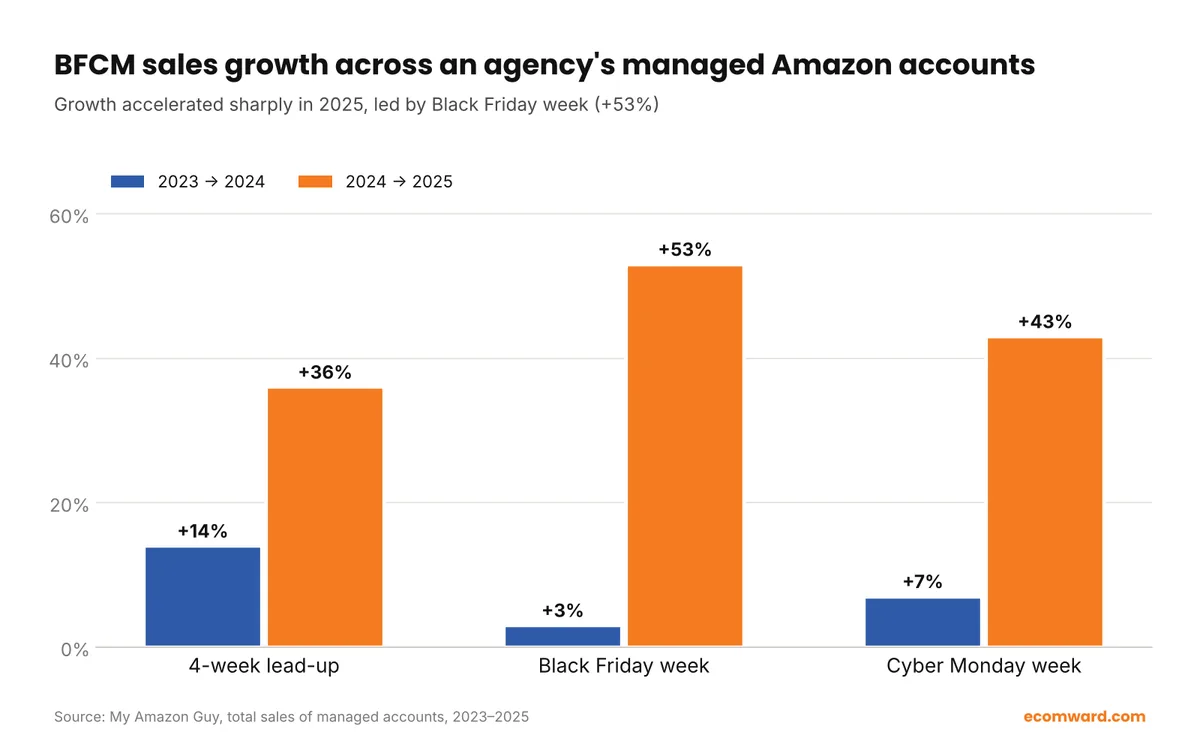
Their 2025 lead-up weeks alone produced about $754,833 more in sales per week than in 2024. The pattern is clear: the growth was built before Black Friday, not on it. Across this data and the case studies below, the sellers who won Amazon BFCM did six things.
Winning move 1They started 4 to 10 weeks early
Winning sellers ramped up ads and promotions at least four weeks before Black Friday. Earlier sales velocity improves organic rank, and the ad data from those weeks shows which keywords actually convert. When CPCs spike during Cyber 5, you already know where to put your budget.
Winning move 2They moved budget to proven converting keywords
Instead of raising every bid, top sellers increased budgets on keywords and products with a history of conversions and paused the rest. Pacvue’s historical data shows Amazon ad costs start rising about four days before Black Friday and stay high until about four days after Cyber Monday, so this is the window where wasted spend hurts most. They also raised budgets before bids, because a campaign that runs out of money at 2 p.m. on Black Friday can’t capture the evening rush.
Winning move 3They used a discount ladder, not one big discount
Rather than starting at 40% off, winning sellers began with the smallest discount that still earned a deal badge, then deepened it only if sales slowed. This protects margin and the reference price you need in December. Prime Exclusive Discounts were the safer default because you control timing and get a strikethrough price, while Lightning Deals were used for short bursts on specific products.
Winning move 4They fixed their listings before the traffic arrived
Holiday traffic only pays off if it converts. Winners refreshed images and A+ Content with holiday themes, made sure listings read well on mobile, and answered real shopper questions in titles, bullets and A+ comparison charts so AI shopping assistants like Rufus could surface them.
Winning move 5They protected inventory and the Buy Box
A stockout during Black Friday week doesn’t just lose sales. It hands the Buy Box and your ad placements to a competitor, and you spend January rebuilding organic rank. Winning sellers worked backward from FBA arrival deadlines, audited inventory weekly, and kept backup stock in a 3PL or for FBM.
Winning move 6They kept selling after Cyber Monday
Traffic drops after Cyber Monday, but shoppers keep buying until the December shipping cutoffs. Top sellers kept Sponsored Display retargeting running at lower spend to reach shoppers who viewed but didn’t buy during BFCM, while competitors switched their ads off.
Amazon BFCM Case Studies: Real Seller Results
Case study 1: K’lani, 250% more BFCM sales
K’lani, a hair accessories brand doing $500k to $1M a year on Amazon, went into the 2024 holiday season with unstable ACoS, tight inventory and rising competitor CPCs. Its agency ran a full PPC audit, moved spend to top-performing keywords, merged variations to combine reviews, refreshed every listing with holiday images and activated Prime Exclusive Discounts. Inventory was audited weekly to prevent stockouts.
Result: a 250% year-over-year increase in Black Friday Cyber Monday month sales.
Case study 2: Reentel, $1.7M in Q4 sales
Reentel, a tools and home improvement brand, had no plan for rising CPCs, lost the Buy Box on key products as ad volume grew, and had traffic that wasn’t converting. The fix was a full-funnel ad structure using Sponsored Products, Sponsored Brands and Sponsored Display, new A+ Content, images and Brand Store pages, and budgets that scaled into the BFCM peak while ACoS and TACoS were checked daily. After Cyber Monday, Sponsored Display retargeting and bundled holiday promotions kept sales going.
Result: Q4 sales of more than $1.7 million, 20% year-over-year growth, with ACoS held near 20% and TACoS under 5%.
What the sellers who struggled had in common
Not everyone had a record BFCM 2025. In Amazon’s own Seller Central forums (Europe), some long-time sellers said their holiday sales were the weakest they’d seen, while others said the period went well. A common complaint was that Amazon’s pricing rules and year-round competition left little room to discount on Black Friday without hurting margins.
The sellers who struggled usually had one or more of these problems: deals submitted late or rejected, stock arriving after the cutoff, ads switched on only during event week, discounts too deep to be profitable, or listings that didn’t convert mobile traffic.
What to Expect From Amazon BFCM 2026
Adobe forecasts another record season in 2026:
Other trends that will shape BFCM on Amazon this year:
- Mobile will dominate. A record 63% of Cyber Week online spend is expected to come from phones, so your main image, title and first bullets have to sell on a small screen.
- AI shopping keeps growing. Adobe expects traffic from AI tools to retail sites to rise another 130% this holiday season.
- Discounts of up to 30% off list price are expected during Cyber Week.
- Buy Now, Pay Later is forecast to drive $21.3 billion in holiday spending, including $1.09 billion on Cyber Monday.
- Prime Big Deal Days on October 6 and 7 was forecast to bring in nearly $10 billion online, pulling some holiday demand into October.
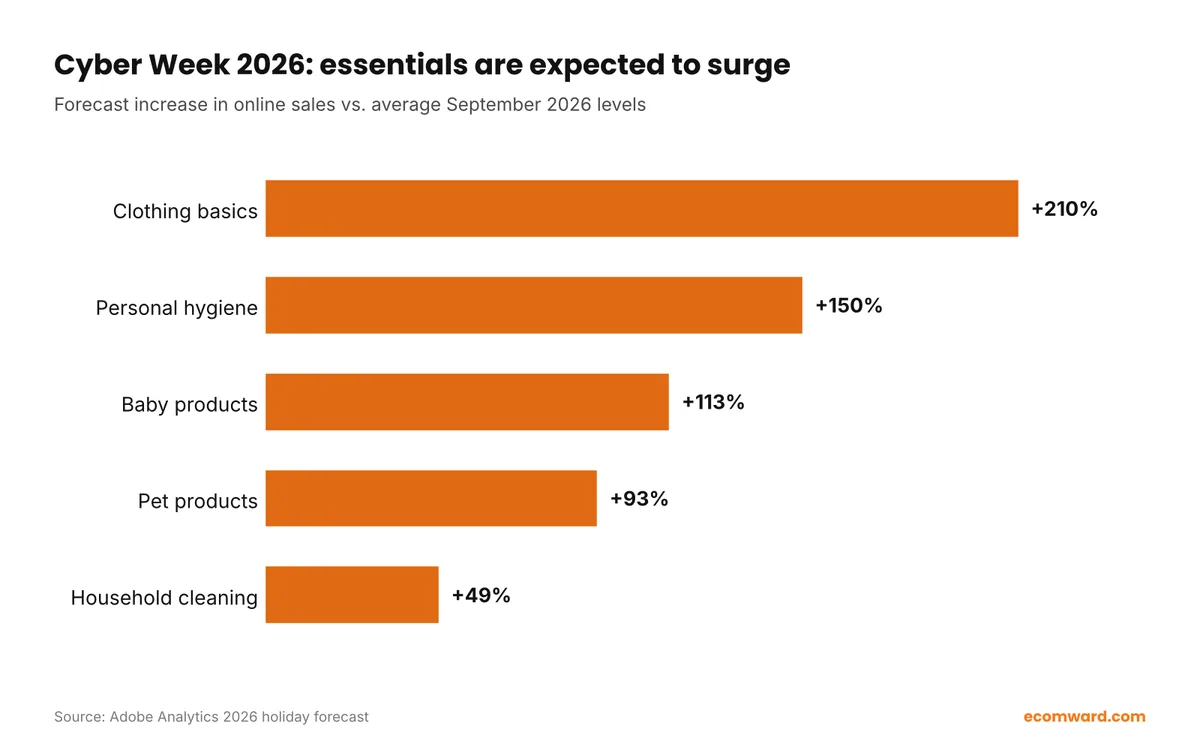
Essentials will be the big winners
Following the 2025 pattern, shoppers are expected to use Cyber Week deals to stock up. If you sell consumables, baby, pet or personal care products, plan for a bigger Cyber Week spike than usual.
Amazon BFCM 2026 key dates
| Date | What happens |
|---|---|
| Oct 15, 2026 – Jan 14, 2027 | Holiday peak FBA fulfillment fees apply |
| Oct 20 | Final deadline to submit Black Friday Week and Cyber Monday deals |
| Oct 21 | FBA arrival target, minimal shipment splits |
| Oct 28 | FBA arrival target, Amazon-optimized shipment splits |
| ~Nov 19–20 | Expected start of Amazon Black Friday Week (not yet announced; 2025 started Nov 20) |
| Nov 26 | Thanksgiving |
| Nov 27 | Black Friday 2026 |
| Nov 30 | Cyber Monday 2026 |
Should You Hire an Amazon Agency for BFCM?
You can run Amazon BFCM yourself, and many sellers do. But the 2025 data shows how much depends on doing a lot of things at once and on time: deal submissions, FBA cutoffs, margin checks, bid and budget changes, listing updates and daily monitoring during event week. That’s why many brands bring in an Amazon agency for Q4.
A good Amazon management agency usually helps in four places during BFCM:
- PPC management: building full-funnel campaigns, moving budget to converting keywords and watching ACoS and TACoS every day of the event.
- Listing optimization: fixing titles, images, bullets and A+ Content so the extra traffic actually converts.
- Deals and pricing: choosing hero products, planning a discount ladder and checking that each deal stays profitable after fees.
- Inventory planning: working back from Amazon’s arrival deadlines so you don’t run out during Black Friday week.
Both case studies above came from brands working with an Amazon management agency. If you’re comparing agencies for Amazon BFCM 2026, ask for real holiday results from past clients, how they handle rising CPCs, and how they protect profit, not just revenue.
Your Amazon BFCM 2026 Action Plan, Based on 2025 Data
- Submit your Black Friday and Cyber Monday deals by October 20, starting with your hero products
- Get FBA inventory checked in by October 21 or 28, and keep backup stock for FBM
- Recalculate margins with peak fees, deal fees and holiday CPCs before you set discounts
- Start ramping up ads now, at least four weeks before Black Friday, to build sales history and keyword data
- Add or scale Sponsored Brands campaigns, the best-performing format on Black Friday 2025
- Plan to spend more on Black Friday itself, where 2025 ROAS was stronger than Cyber Monday
- Raise budgets before bids, and move spend to keywords with proven conversions
- Use a discount ladder and Prime Exclusive Discounts instead of one deep discount
- Refresh images, A+ Content and bullets for mobile shoppers and AI assistants like Rufus
- Judge results by ROAS, TACoS and profit, not just CPC or revenue
- Keep Sponsored Display retargeting running through December
Want a second pair of eyes before Black Friday? ECom Ward is an Amazon agency that audits listings and PPC accounts and shows you exactly what to fix before Amazon BFCM traffic arrives. Get in touch for a free audit.
Frequently Asked Questions
What is Amazon BFCM?
Amazon BFCM stands for Black Friday and Cyber Monday on Amazon. Amazon runs it as a Black Friday Week and Cyber Monday deal event that lasted 12 days in 2025 (November 20 to December 1). For many sellers it’s the biggest sales period of the year.
How much did shoppers spend on Black Friday and Cyber Monday 2025?
According to Adobe Analytics, US shoppers spent $11.8 billion online on Black Friday 2025 (up 9.1%) and $14.25 billion on Cyber Monday 2025 (up 7.1%). Cyber Week, from Thanksgiving to Cyber Monday, reached $44.2 billion.
When is Amazon Black Friday 2026?
Black Friday 2026 is on November 27 and Cyber Monday 2026 is on November 30. Amazon hasn’t announced the dates of its 2026 Black Friday Week event yet. In 2025 the event ran for 12 days, from November 20 to December 1, so plan for deals and ads to go live around November 19 or 20.
Is Black Friday or Cyber Monday better for Amazon sellers?
Cyber Monday is still the biggest online sales day, but Black Friday is growing faster. In 2025, Amazon advertisers increased spend on Black Friday and cut it on Cyber Monday, and Black Friday delivered stronger ROAS for Sponsored Ads and DSP. Plan for both days, but don’t hold your best deals back for Cyber Monday.
How much do Amazon PPC costs rise during BFCM?
It depends on the category. Pacvue’s historical data shows Amazon ad costs start rising about four days before Black Friday and stay high until about four days after Cyber Monday. In 2025, Pet Supplies and Baby Products saw big CPC increases, while Electronics, Clothing, Toys and Beauty actually saw lower CPCs and higher ROAS than in 2024.
What is a good ACoS during Black Friday and Cyber Monday?
There’s no single number, because it depends on your margin. Many sellers accept a higher ACoS during BFCM in exchange for sales velocity and better organic rank. A better guide is TACoS and profit per order. In one 2024 case study, a brand kept ACoS near 20% and TACoS under 5% while growing Q4 sales 20%.
Does an Amazon management agency help during BFCM?
It can. An Amazon management agency handles the deadlines, PPC changes, listing updates and daily monitoring that BFCM demands. In the 2025 agency data above, managed accounts grew Black Friday week sales 53% year over year. Results depend on the brand and the agency, so ask for past holiday results before you hire.
Is it too late to prepare for Amazon BFCM 2026?
No, but some deadlines are close. Deal submissions close on October 20 and FBA arrival targets are October 21 and 28. Even if you miss those, you can still use coupons and Prime Exclusive Discounts, ramp up ads, improve your listings and set up retargeting before Black Friday Week starts.
Sources
- Adobe: Cyber Monday 2025 results
- Adobe: 2025 holiday shopping season results
- Adobe: 2026 holiday shopping forecast
- Pacvue & Helium 10: 2025 Cyber 5 Benchmark Report
- My Amazon Guy: BFCM performance 2023–2025 and case studies
- Modern Retail: Amazon skips its BFCM recap
- About Amazon: Black Friday Week 2025 dates
- SalesDuo: Amazon 2026 Q4 seller deadlines